Air pollution is the exposure almost nobody chooses and almost everybody has. Worth understanding, because the sensible responses are not the obvious ones.
PM2.5, and why the number refers to size
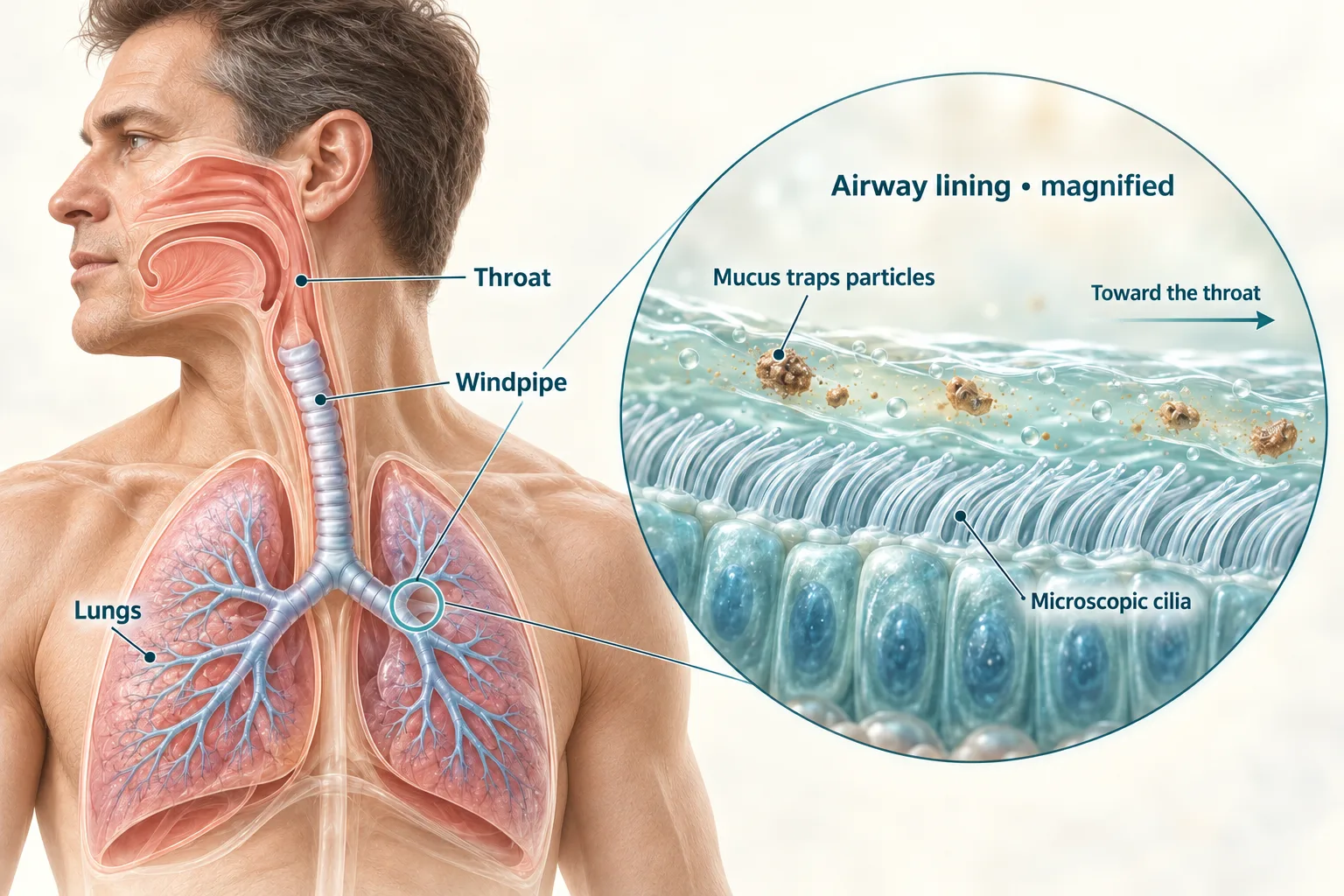
PM2.5 means particulate matter under 2.5 micrometers across — roughly a thirtieth the width of a human hair. That size is the point of the measurement. Larger particles are caught in the nose and upper airways and cleared. Particles this small travel to the deepest parts of the lung and some cross into the bloodstream.
The main sources are combustion: traffic, industry, wood burning, wildfires, and cooking indoors.
What the research says, carefully
Long-term exposure to higher particulate levels is associated with faster lung function decline and higher rates of chronic respiratory disease. The association is consistent across many large studies in many countries.
What is harder to state precisely is how much difference it makes to any individual. These are population-level effects, averaged over large groups, and your personal trajectory depends on a great deal more than your ZIP code. Someone who smokes in clean air is in considerably more trouble than a non-smoker in a polluted city.
Reading an air quality index
In the United States the AQI runs on a familiar color scale. Under 50 is good. Fifty to 100 is moderate. Above 100, sensitive groups — which includes people with asthma, older adults and children — start to be affected. Above 150 everyone is, and above 200 it is genuinely unhealthy.
Any weather app will show it. The useful habit is checking it before outdoor exercise rather than afterwards.
What actually reduces exposure
Exercise indoors on bad days. This is the biggest single lever, because exercise multiplies how much air you move. An hour of hard outdoor running on a 160 AQI day delivers a remarkable dose.
Shut the windows when it is bad outside, open them when it is not. Ventilation is normally the cheapest improvement available and on those specific days it is the opposite.
Run a HEPA filter in the bedroom. Particulate only; it does nothing for gases.
Avoid the roadside where you can. Concentrations fall steeply with distance from traffic. A parallel residential street is measurably cleaner than the main road, and walking or cycling on it costs you nothing.
Use the extractor fan when cooking. Frying on a gas hob can produce indoor levels exceeding anything outside your door, and this is the exposure most people never think about at all.
On masks
A fitted N95 or FFP2 does filter fine particulate and is worth having for wildfire smoke days. A surgical or cloth mask does not meaningfully filter PM2.5, and wearing one for air quality is largely ceremonial.
Questions people also ask
What is PM2.5 and why does the size matter?
Particles under 2.5 micrometers, roughly a thirtieth of a hair's width. Size is the whole point: bigger particles get trapped and cleared up top, while these reach the deepest airways and a fraction crosses into the blood.
How strong is the link between air pollution and lung health?
Consistent across large population studies: higher long-term particulate exposure tracks with faster decline. For any one individual it is a smaller lever than smoking or indoor air, which is worth keeping in proportion.
At what AQI should I exercise indoors?
Over 100 if you are in a sensitive group, over 150 for anyone. Hard exercise multiplies the volume of air you process, so an outdoor session on a bad day delivers a dose far out of proportion to the time spent.
One Small Daily Habit
Packages from $49 a bottle, every one with the same 60-day guarantee.
See Package PricingThese statements have not been evaluated by the Food and Drug Administration. BreathiZen® is a dietary supplement and is not intended to diagnose, treat, cure or prevent any disease. Nothing here is medical advice. Prices, shipping and guarantee terms are set by the official retailer and confirmed at checkout. Speak to your doctor before starting any supplement.
Sources and further reading← Back to all articles