This is the page we would hand someone who had just been told their lung function is "normal for your age" and wanted to know what that sentence actually means.
The shape of the curve
Lung function rises through childhood and adolescence, peaks somewhere in the early-to-mid twenties, holds roughly level for a few years, and then begins a decline that continues for the rest of your life.
That decline is usually quoted at around one percent a year, or roughly 25 to 30 milliliters of FEV1 annually in a healthy non-smoker. Both numbers describe the same gentle slope. It is not a disease process. It happens to everyone, including people who have never smoked and exercise daily.
Decade by decade
Twenties
Peak, or very near it. Whatever maximum you were going to reach, you have reached it. Nothing you do now raises the ceiling; what you do now sets how much you keep.
Thirties
The decline begins, and it is completely invisible. A few percent off a maximum you never use at rest changes nothing you can feel. This is the decade where habits are cheapest to change and least likely to be changed, for exactly that reason.
Forties
Ten to fifteen percent down from peak for most people. Still invisible day to day, but it starts showing in hard efforts — the last hill, the second flight carrying something heavy, the game of football with someone twenty years younger.
Fifties
Around twenty percent down, and the decade where most people first notice. Not because the slope steepened, but because the spare capacity that was absorbing it finally ran thin.
Sixties and beyond
Thirty percent down and continuing. The rib cage stiffens, the respiratory muscles weaken slightly, and the small airways lose some of their elastic recoil. All of this is ordinary aging, and all of it is survivable — most people in their seventies have ample lung function for ordinary life, which is precisely why the decline goes unnoticed for so long.
What makes the slope steeper
Smoking is first by a wide margin, roughly doubling the annual rate and often worse. Occupational and environmental exposure — dusts, fumes, solvents, wildfire smoke — is second and chronically under-counted, because it arrived a day at a time over thirty years. Repeated significant chest infections each leave a small mark. Severe uncontrolled asthma accelerates it too.
What flattens it
Stopping smoking, which bends the line back toward the normal rate within a couple of years at any age. Reducing exposure where you can. Regular aerobic exercise — which does not raise measured lung capacity in healthy adults, but substantially improves what you can do with the capacity you have. And ordinary maintenance: vaccination against flu and pneumococcus, treating asthma properly, and keeping indoor air reasonable.
What about mucus and clearance?
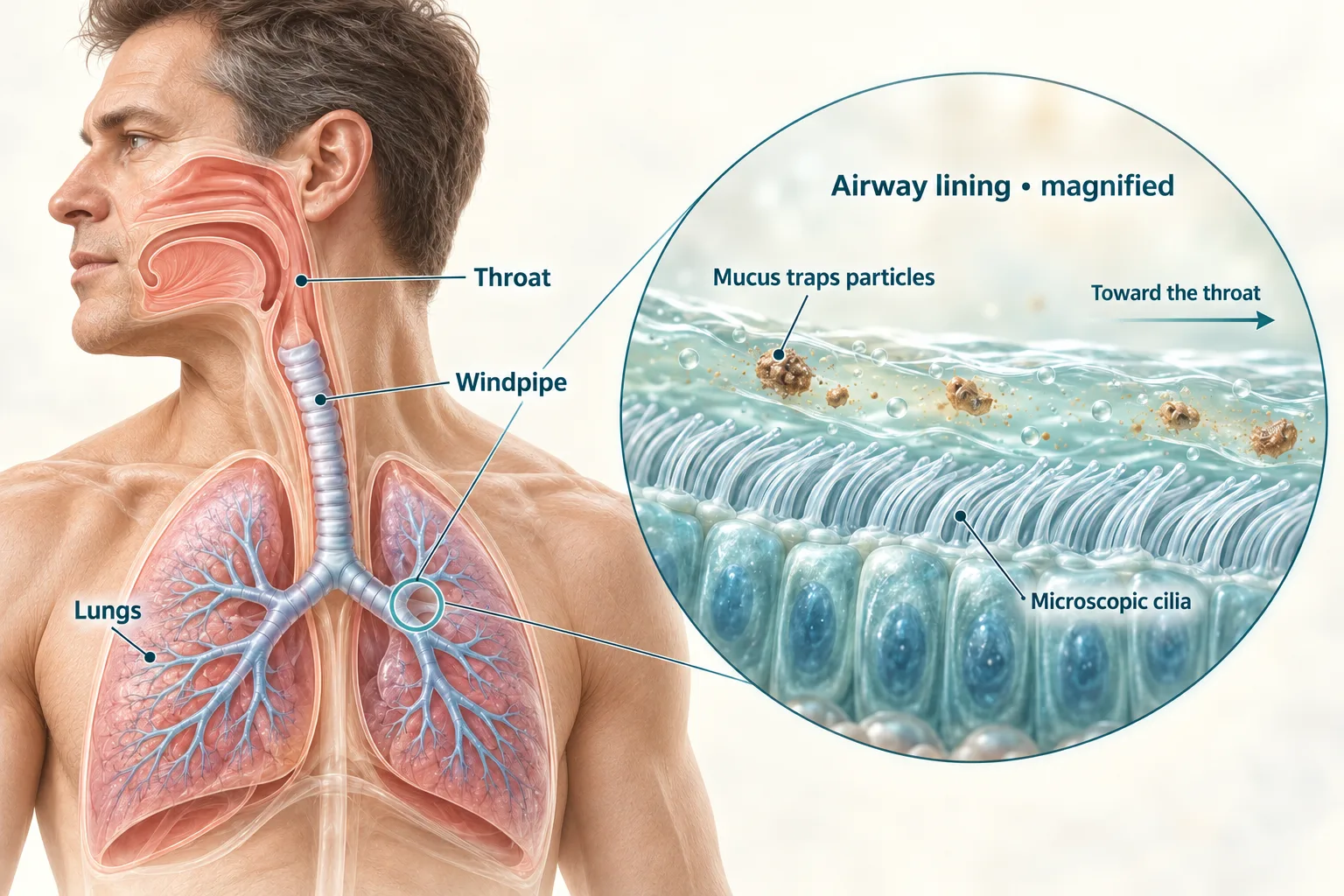
Running alongside the decline in function is a slower airway clearance system, which is where searches for BreathiZen mucus support generally originate. Worth separating the two: clearance and lung function are different measures, and a daily botanical routine sits alongside fluid and humidity in the first category rather than doing anything to the second.
The one thing worth taking away
You cannot recover lung function that is gone. You can change the slope from today forward, and the slope compounds over decades. That is an argument for acting in the decade before you notice anything rather than the decade after.
Questions people also ask
What is a normal rate of lung function decline?
Around one percent of your peak each year once you are past your early thirties, which works out near 25 to 30 milliliters of FEV1 annually in someone who has never smoked. Both are population averages, not a forecast for any one person.
Can you improve lung function after 50?
You can improve what you are able to do with it, and by a lot. You cannot raise measured lung capacity, and tissue already gone stays gone. After fifty the realistic goals are a gentler slope and better conditioning — which together account for most of what people actually notice.
What is good lung capacity for my age?
Spirometry scores you against a predicted value for your age, height, sex and ethnicity, and eighty percent of predicted or better is the usual normal band. Worth noting the predicted value itself drops as you age, so normal for your age and near your own peak are two different statements.
Does BreathiZen help with lung health?
It is a botanical oral spray, not a medicine, and it claims to treat nothing. A BreathiZen lung health routine sits in the same tier as fluid intake and bedroom humidity: supporting habits. It is not a stand-in for quitting, moving, or seeing a doctor.
The Small Daily Piece
Nine botanicals, every amount on the label, and 60 days to decide.
See Package PricingThese statements have not been evaluated by the Food and Drug Administration. BreathiZen® is a dietary supplement and is not intended to diagnose, treat, cure or prevent any disease. Nothing here is medical advice. Prices, shipping and guarantee terms are set by the official retailer and confirmed at checkout. Speak to your doctor before starting any supplement.
Sources and further reading← Back to home