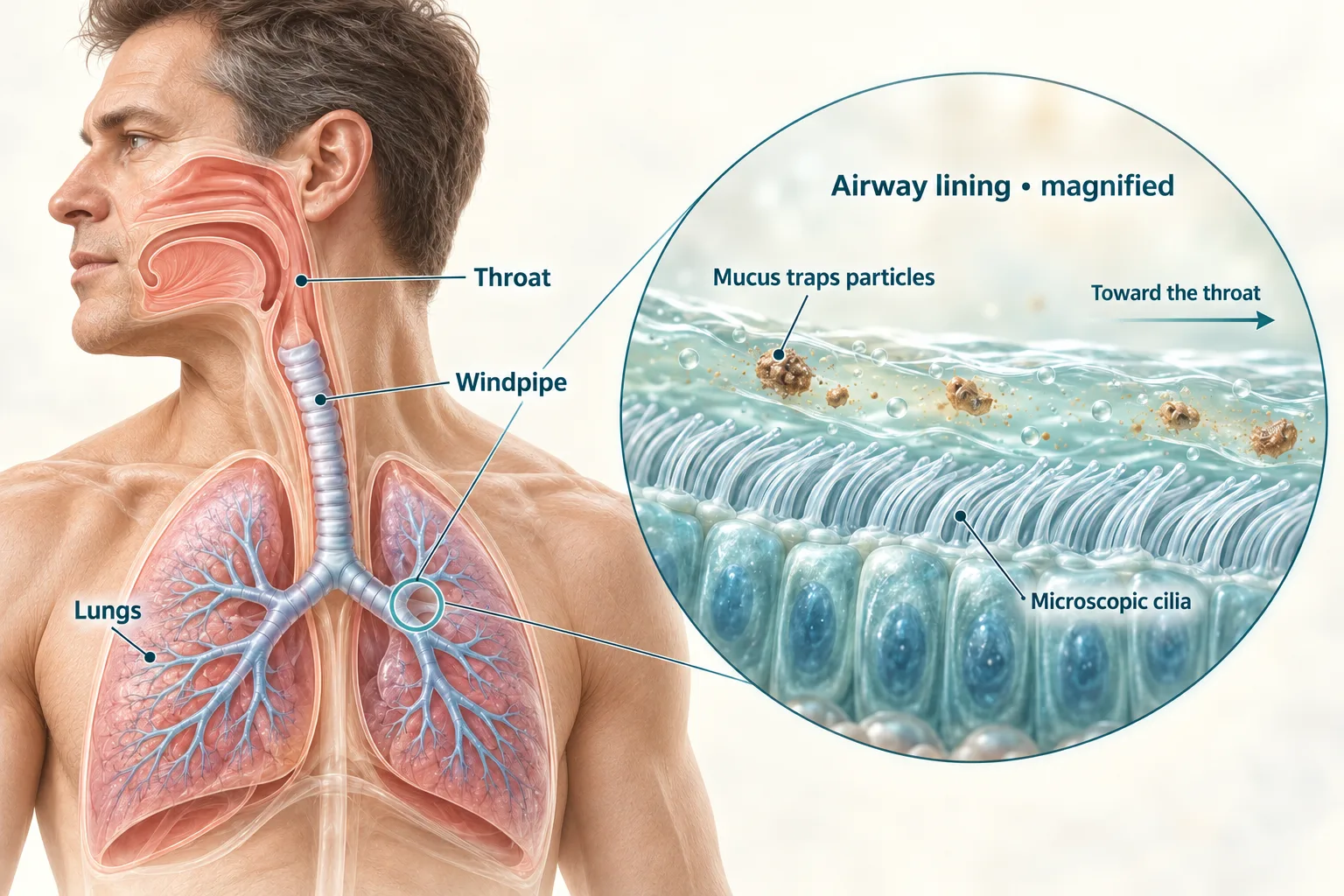
Almost everyone assumes their lungs are roughly as good as they were a decade ago, right up until the afternoon they are not. The truth is less dramatic and considerably more useful: the decline started a long time ago and has been running quietly ever since.
The rise, the plateau, the fall
Lung function grows through childhood and adolescence alongside the rest of the body, peaks somewhere in the early to mid twenties, and holds roughly level for a few years. Then it begins a slow fall, usually quoted at about one percent of peak per year, that continues for the rest of your life.
Your peak is not something you chose. It was set by genetics, by how tall you ended up, by childhood illnesses and childhood air. Nothing available to an adult raises that ceiling. What remains open is how much of it you keep.
What is physically changing
Three things, running in parallel.
The lung tissue loses elastic recoil. Healthy lungs behave somewhat like a sponge that springs back when squeezed. That springiness fades gradually, which means emptying the lungs takes slightly more effort each decade.
The rib cage stiffens. The joints between ribs and spine lose flexibility, and the chest wall becomes a less willing bellows. This is pure mechanics and it happens to everyone.
The respiratory muscles weaken a little. The diaphragm is a muscle and ages like other muscles — which is one of the few parts of this list that responds to exercise.
Why it stays invisible for twenty years
Because you were built with enormous surplus. At rest you use a small fraction of your lung capacity, and even brisk walking does not come close to the limit. The first two decades of decline are absorbed entirely by capacity you were never using.
The result is a long silence followed by what feels like a sudden change. In their fifties people describe lungs that "went downhill fast". Generally they did not. The margin simply got thin enough to notice, after twenty years of getting thinner.
The number worth carrying around
One percent a year does not sound alarming, and on its own it is not. Compounded over forty years it is the difference between taking the stairs without thought and pausing on the landing. That is the whole argument for caring about the slope in your forties rather than your sixties.
What this does and does not mean for you
It does not mean decline is a problem to be solved; it is not solvable. It means the rate is partly yours to set. Smoking roughly doubles it. Decades of occupational dust and fumes add to it. Repeated chest infections each leave a mark. And on the other side, stopping smoking bends the line back toward normal within a couple of years, at any age.
That is a short list, but it is a real one, and it is more than most people realize they have.
Questions people also ask
At what age does lung function peak?
Early to mid twenties for most people, then a brief flat stretch. Where that peak lands was decided by genetics, how tall you grew and what your childhood lungs went through. No adult intervention lifts it.
Is lung function decline a disease?
It is not. Lifelong non-smokers who train every day are on the same curve. What counts as disease is a slope steeper than the normal one, never the existence of a slope.
One Small Daily Habit
Packages from $49 a bottle, every one with the same 60-day guarantee.
See Package PricingThese statements have not been evaluated by the Food and Drug Administration. BreathiZen® is a dietary supplement and is not intended to diagnose, treat, cure or prevent any disease. Nothing here is medical advice. Prices, shipping and guarantee terms are set by the official retailer and confirmed at checkout. Speak to your doctor before starting any supplement.
Sources and further reading← Back to all articles