The two words get used interchangeably and they are not quite the same thing. The distinction is small but it clears up a surprising amount of confusion about what is happening and where.
Mucus versus phlegm
Mucus is the general term. Your body produces it across every mucous membrane you have — nose, sinuses, airways, gut, eyes. Roughly a liter a day from the respiratory tract alone, almost all of it swallowed without your knowledge.
Phlegm is the subset produced in the lower airways and brought up by coughing. All phlegm is mucus; most mucus never qualifies as phlegm. When a clinician says sputum, phlegm is what they mean.
Practically: phlegm in the throat that you coughed up came from your chest. Material you cleared without coughing, or blew out, came from upstairs.
Why the body makes mucus in the first place
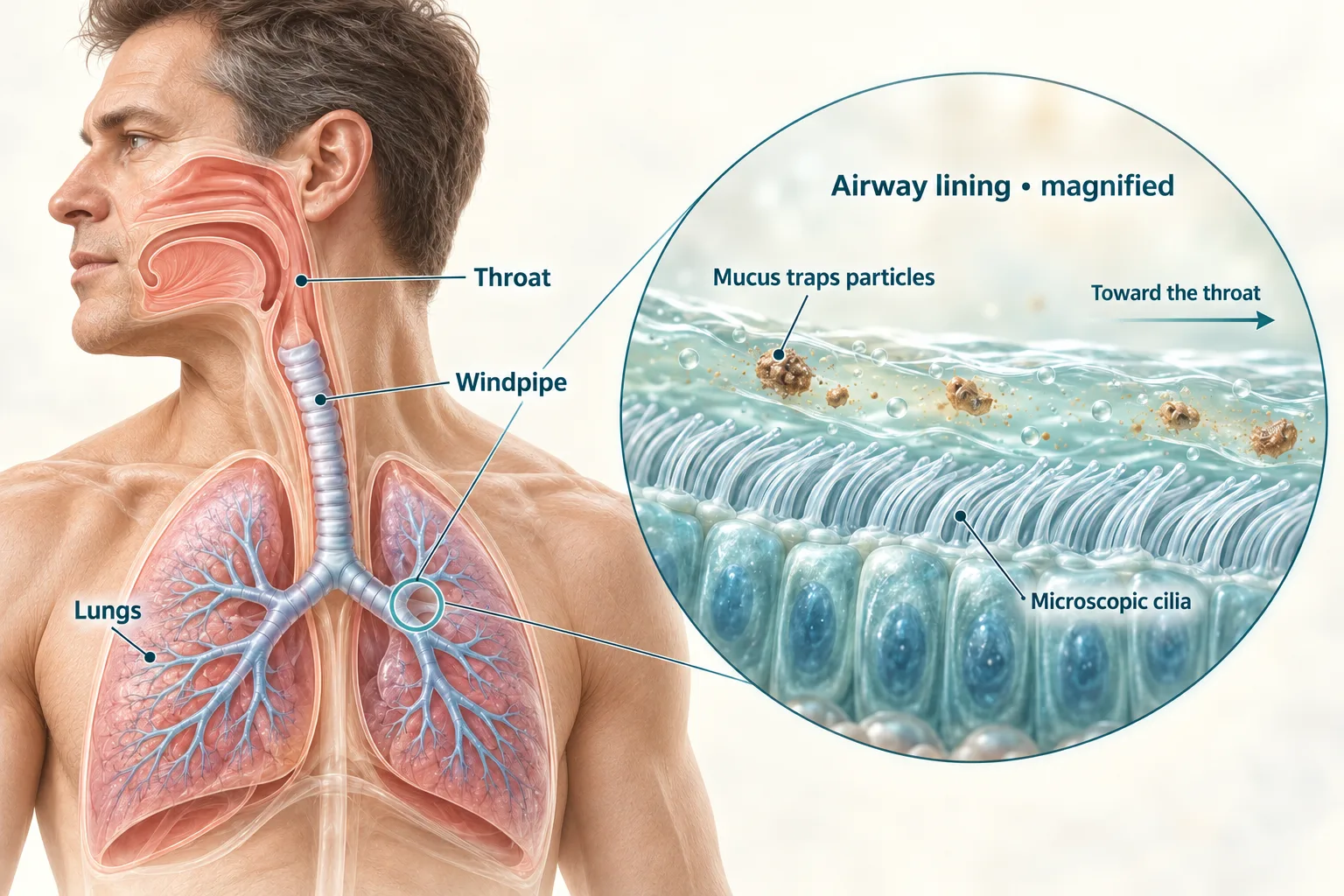
It is a trap, and a good one. Every breath carries dust, pollen, bacteria, viruses and whatever else was in the room. A sticky layer across the airway catches that cargo before it reaches delicate lung tissue.
It also carries antibodies and antimicrobial compounds, and it keeps the lining moist. Airways that dry out stop working properly within hours, which is why dry air registers so quickly as discomfort.
So mucus is not a malfunction. A complete absence of it would be considerably worse than too much.
How airways clear mucus, continuously
Trapping is only useful if the trap empties. Mucus clearance runs on cilia — microscopic hairs, hundreds per cell, lining the airway.
They beat in coordinated waves and drive the mucus layer steadily upward toward the throat, where it is swallowed. Picture an escalator that never stops. Material arrives, gets caught, rides up, and is dealt with by your stomach acid. The entire process is invisible when it works.
Why it slows
Dehydration, because the cilia beat inside a thin watery layer that thins when you do. Dry air, which pulls moisture out of the lining directly. Smoke, which paralyzes cilia and then destroys them. Lying flat, which removes gravity's small assist. Infection, which damages cilia temporarily and explains why a cough can outlast a cold by weeks. And age, which slows the beat frequency gradually.
Mucus in the chest versus mucus in the throat
Mucus in the chest means the lower airways, and it announces itself by requiring a cough to shift. The useful levers are fluid, humidity, movement and deeper breathing.
Throat mucus is more often drainage from above, and responds to saline rinses and treating whatever is irritating the nose. Coughing up mucus that is thick and persistent tells you which floor you are on.
When volume genuinely has increased
It does happen. Infection raises production sharply and briefly. Allergy raises it seasonally. Chronic irritation increases the number of mucus-producing cells over years, which is the long-term smoker's situation. And some conditions alter the mucus itself rather than its quantity.
The rule of thumb: a short-lived increase with an obvious cause is ordinary. A sustained change over months, or anything with blood in it, is a conversation with a doctor rather than a remedy to manage.
Questions people also ask
What is the difference between mucus versus phlegm?
Mucus is the general term for what every mucous membrane produces. Phlegm is specifically the portion from the lower airways that you cough up. All phlegm is mucus; very little mucus ever becomes phlegm.
Why does the body make mucus at all?
It is a trap. Every breath carries dust, pollen and bacteria, and a sticky layer catches that cargo before it reaches lung tissue. It also carries antibodies and keeps the lining moist. None at all would be far worse than too much.
What causes mucus buildup in the chest?
Slowed transport rather than raised production, nearly always. Dehydration, dry air, smoke, lying flat and recent infection all slow the escalator, and an ordinary volume moving slowly feels exactly like extra volume.
What does morning phlegm indicate?
A backlog rather than a problem. Morning phlegm is the overnight accumulation from eight hours of slow clearance, arriving at once when you stand up and start moving.
One Small Daily Habit
Packages from $49 a bottle, every one with the same 60-day guarantee.
See Package PricingThese statements have not been evaluated by the Food and Drug Administration. BreathiZen® is a dietary supplement and is not intended to diagnose, treat, cure or prevent any disease. Nothing here is medical advice. Prices, shipping and guarantee terms are set by the official retailer and confirmed at checkout. Speak to your doctor before starting any supplement.
Sources and further reading← Back to all articles